
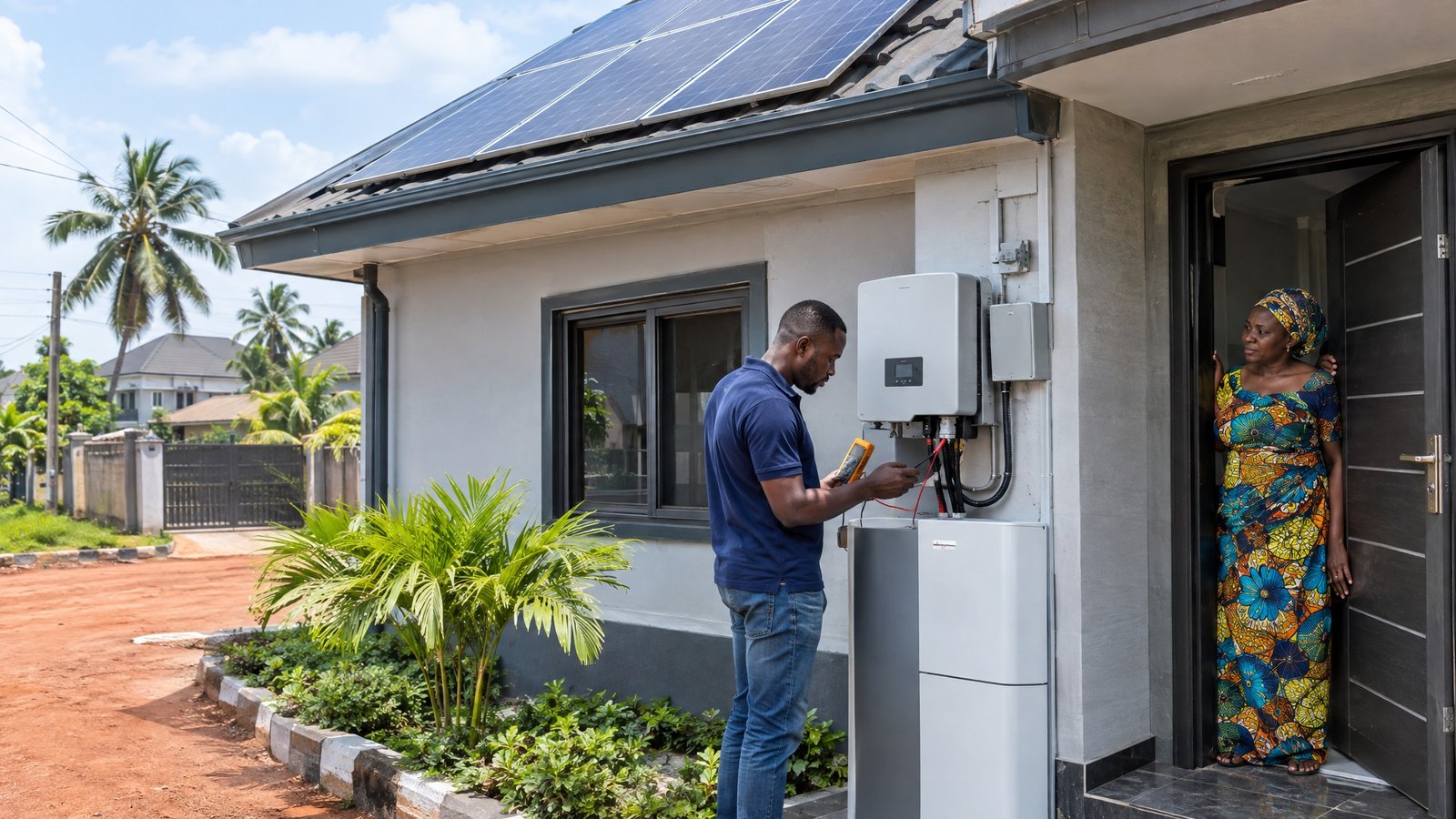
Buying solar in Nigeria has never been more ordinary. Panels on the roof, a battery in the compound, an inverter on the wall, and a monthly payment plan instead of buying petrol for the generator. It has also never been more confusing, because almost nobody sells you a system. Most Nigerians buy a pile of equipment, hire somebody with a screwdriver, and hope the physics works out.
At Nigeria Energy Week in Lagos, one of the country’s solar equipment makers put the blame where it belongs. The hardware is generally fine. The installation is not. The warning from the company’s technical support manager was blunt: improper installation and badly configured equipment are among the most common causes of faults in home solar systems, and they are entirely avoidable before a single naira is spent.
The Four Mistakes That Break Solar Systems
Four specific problems were named, and none of them are exotic.
- Overloading. Connecting more appliances than the inverter and battery bank are designed to carry. It is the digital equivalent of overloading a generator with a welding machine, and it shows up as heat, shutdowns and a shortened battery life.
- Missing or wrong protection. The protective gear that isolates a fault before it takes the whole system with it. Skip it and one short becomes one dead unit.
- Installation errors. Cabling, connections, mounting and earthing done badly. This is the part that looks like nothing until the rainy season starts and the faults begin.
- Mismatched sizing. Panel capacity that does not match the inverter and battery specifications. Buy too little solar and the system never performs; buy too much and you have paid for capacity you will never use.
None of that is a brand problem, and that is the point. It is a design and workmanship problem, which is exactly why the advice from the floor was to insist on certified engineers and proper configuration before installation begins, rather than after the first failure.
After-Sales Is the Product Nobody Shops For
The more revealing part of the presentation was not the fault list but the service system described around it. Customers are expected to call a support line. A call-centre agent documents the complaint, passes it to an engineer working remotely for assessment, and where the fault cannot be resolved remotely, a field engineer is sent out to decide whether the unit needs repair or replacement. The promise attached to that process is a resolution window of forty-eight hours, with repair or replacement as the outcome, subject to the applicable warranty.
There is also a replacement policy that lets a customer keep using a working unit while the faulty one is being sorted out, which matters more than it sounds: a solar system is not a decoration, and a week without power is a real cost to a household. A distributor of the products, Rotimi Thomas, who runs SunFi, put the commercial logic plainly. “The 48-hour resolution commitment from itel Energy is very important for us as a distribution platform because we don’t make the product,” he said. “When a consumer buys a product through SunFi, they’re actually buying a trusted service.”
That is a better question to ask than “which brand is best”. It is the question behind the push to fix the national grid and behind the Renewable Energy Authority Bill that lawmakers have advanced: who answers when the power does not come on, and how fast?
The Real Barrier Is Upfront Cost, Not Technology
Here is the part that surprised nobody at the exhibition and still deserves to be said plainly. The obstacle to household solar in Nigeria is no longer the technology. It is the payment. With interest rates high and equipment prices rising, a complete system with storage is a big number to find at once, and the people who need it most are the ones with the least access to it.
One response is spreading the cost: an initial payment followed by the balance spread over anything from three to twenty-four months or longer. Between thirty and forty per cent of customers were said to be choosing payment plans, which makes it less of a finance product and more of how solar is actually bought in Nigeria now.
It is a financing problem wearing an energy costume, and it is the same pressure showing up everywhere. The squeeze on fuel and cooking gas costs is what pushes households towards solar in the first place, while the 640MW added to the national grid keeps reminding everyone that a stable grid would remove the need for half of this. Related questions about cheaper connectivity at home are covered in our piece on Starlink versus local ISPs in Nigeria, because the same household is paying for power and data on the same budget.
Conclusion
Before you pay anybody for a solar system in Nigeria, ask five questions. What is the total wattage I am installing, and what is the inverter rated for? What protection is being fitted? Who is the certified engineer doing the installation? What is the fault-resolution commitment, in writing? And what happens to the warranty if the fault is mine? If the answers are vague, the system is already costing you more than the quote suggested.