
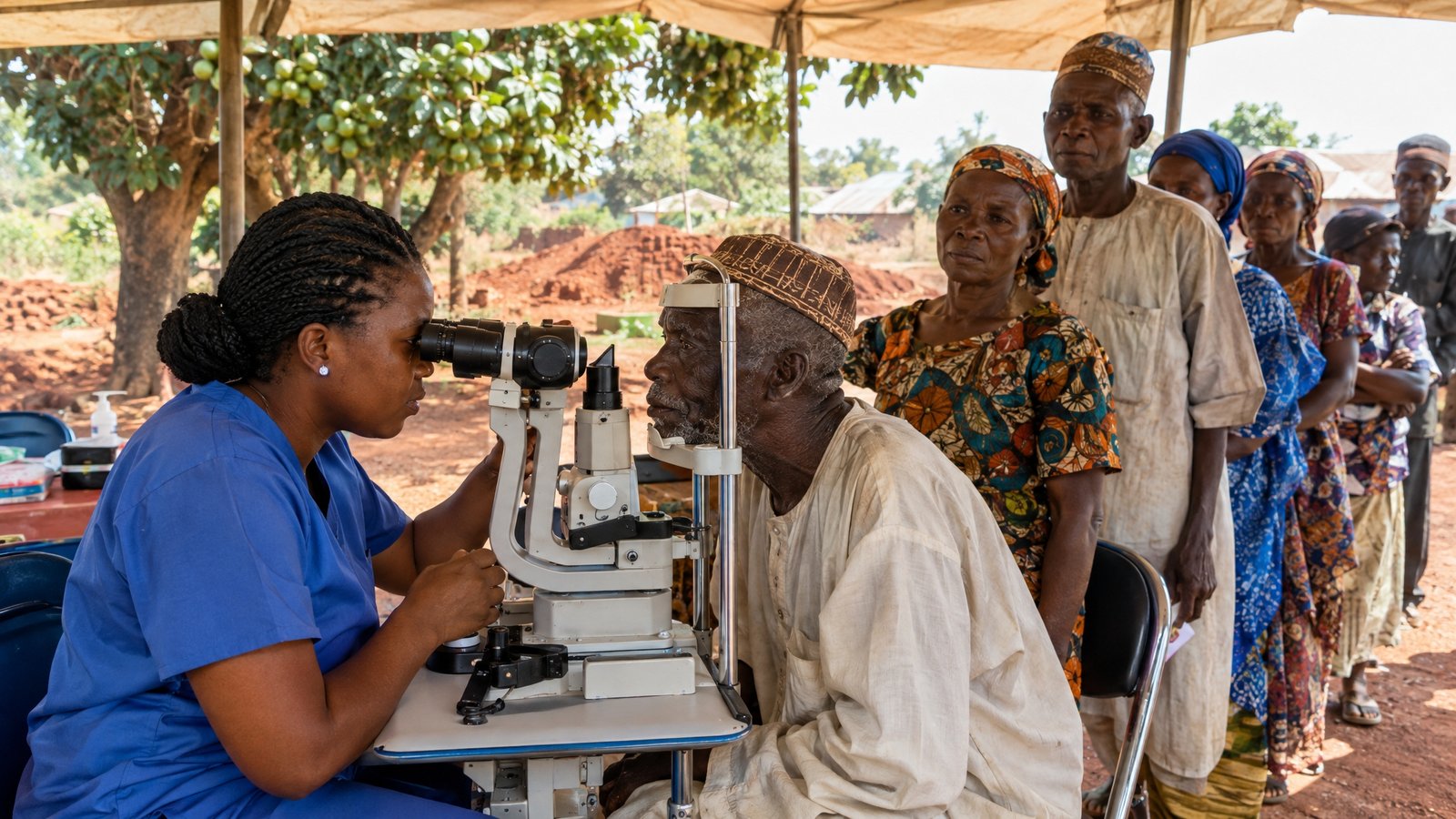
When Asabe Mahmud, 40, from Mariga Local Government Area in Niger State began losing her sight, the consequences did not stay inside her eyes. Her independence went first. Then her daughter Maryam’s education began to suffer.
That is the pattern that runs through this story. Cataracts are described in medical textbooks as a clouded lens that can be replaced in an operation. In Niger State, they are described by the people living with them as a slow slide into poverty that nobody is coming to stop.
The Numbers Behind The Problem
Dr Abdullahi Imam, the Permanent Secretary in the Niger State Ministry of Health and a consultant ophthalmologist, put the scale of it plainly: nine ophthalmologists serve a state of about seven million people.
He also pointed out where those specialists actually are. Although ophthalmologists are distributed across secondary health facilities, the services remain concentrated in the major centres, including Minna and Bida. Residents of remote communities may therefore have to travel long distances to reach specialist care, and that distance grows as the condition worsens.
Umar’s assessment in the state puts the cataract backlog at about 14,000 people, with roughly 5,000 new cases arising every year. He also estimates that cataracts account for 50 to 60 per cent of blindness cases in Niger State.
Those are conservative indicators rather than a verified register of individual patients, and the state’s own disability organisation is candid about that. Muhammad Abubakar Enagi, Executive Director of the Empowerment Initiative of Persons with Disability in Niger State, said the organisation does not yet have a comprehensive, verified statewide record of people living with untreated cataracts because it is still building the capacity to keep one.
Nationally, The Figure Is Larger
Niger State’s numbers sit inside a much bigger national picture. Nigeria’s National Eye Health Strategic Development Plan 2024 to 2028 estimates that more than two million people nationwide need cataract surgery, with over 70 per cent of them living in rural areas. The same plan projects that 612,941 Nigerians were blind from cataracts in 2023.
That last figure is a modelled estimate rather than a register of confirmed patients, which is itself a problem worth naming. The country does not have a reliable count of how many people are waiting for an operation that could restore their sight.
Older survey work points the same direction. An analysis of the National Blindness and Visual Impairment Survey found that 36 per cent of people who were blind from cataracts and had not undergone surgery said they could not afford it. Cataract surgical coverage was measured at 38.3 per cent, falling to 25.3 per cent among women in poor households. Those particular figures come from a survey conducted between 2005 and 2007, so they describe historical access rather than today’s coverage — but nobody has produced a newer national number to replace them.
When Fear Stops People Going
Money is only one barrier, and in some villages it is not the most stubborn one.
Bako has chosen to avoid medical treatment entirely, relying instead on local remedies because he worries an operation could leave him completely blind. His reasoning is painfully logical from where he sits: he can still see, dimly, and a surgical outcome he does not trust could cost him the little he has left.
“Nothing will make me go for treatment. I have been treating it locally, and since I can manage to see, though no longer clearly, I will not go for them to spoil what I have left of my sight. I have heard of people who went for treatment but did not regain their sight,” he said.
His family’s version of the same delay belongs to Malam Adamu. According to his son, Aminu, the family urged him to seek medical attention about ten years ago, and he continued relying on local herbs and refusing hospital treatment. He eventually lost his sight altogether.
Enagi identified the full barrier list: limited information about what services exist, transport costs, distance to hospitals, fear, and inadequate outreach. “When someone loses their sight because of cataracts and cannot afford treatment, life becomes very difficult for both the individual and the family. It can lead to hunger, poverty and hardship,” he said.
What Surgery Changes When It Is Reachable
The other side of that ledger is worth reading too, because the outcomes are not marginal.
Baba Manko, a 65-year-old trader at Kasuwan Gwari Market in Minna, lived with cataracts in both eyes for about three years before undergoing surgery in January through the intervention of a non-governmental organisation. He estimated that treatment would otherwise have cost him more than N60,000 — an amount that would have been very difficult to raise from his trading income. About fifteen other people benefited from the same intervention.
Maimuna Isah, who also benefited from a government intervention, said restoring her sight helped her regain her independence.
And Paul, another patient, paid more than N100,000 for cataract treatment about three years ago. His surgery succeeded and his sight was restored. His experience demonstrates the benefit and the burden in the same breath: the outcome was good, but the household absorbed the entire cost because no one else was going to.
Thirty Surgeries And Two Hundred
Dr Murtala Muhammad Bagana, the state’s Commissioner for Health, announced that 30 free cataract surgeries would be provided during the programme. He also referred to an earlier state eye camp during which more than 200 cataract surgeries were carried out and over 1,000 reading glasses were distributed.
Those are real numbers, and a 200-surgery camp with a thousand pairs of glasses is genuine work. But the comparison with the backlog is unavoidable. An estimated 14,000 people are waiting, and about 5,000 more are added every year. Occasional eye camps cannot absorb a demand curve that steep, which is not an argument against camps — they are among the best things in this story — but an argument for treating them as emergency cover rather than as a service.
The health system’s wider condition makes the eye-care numbers harder to read in isolation. Access to functioning facilities is a live problem in several states — as when a hospital building collapsed in Calabar after heavy rainfall — and health workers have been in dispute with their employers over pay and conditions in more than one region this year, from the resident doctors at UCH Ibadan to allied health workers in Delta State.
A Warning About Internet Cures
Dr Imam issued a caution that is worth repeating loudly. Ordinary eye drops and unverified medicines cannot clear a cataract, and he warned specifically against eye drops and remedies bought online or through social media as supposed cures. Surgery remains the established treatment when the condition significantly affects vision.
For patients who are afraid of an operation, he suggested that reliable information and consultations with qualified eye-care professionals may help address their concerns. Reassurance alone, he was clear, cannot resolve the problem for people who cannot afford treatment in the first place.
Conclusion
Three barriers hold Niger State back: money, distance and fear. Each one is soluble on its own. Money requires a budget line that survives the year. Distance requires specialists posted outside Minna and Bida. Fear requires honest information from people a villager trusts.
What is needed now is a dependable programme, not another round of camps — although every camp is still worth holding. It would also help to have the numbers published in the open, because a waiting list nobody can verify is a waiting list nobody can fund, and the debate about health transparency in Nigeria’s 2027 election is precisely where these lists should be argued from.
Nine ophthalmologists for seven million people is a ratio that cannot be fixed by goodwill, and 14,000 people waiting for an operation is a queue that no thirty-surgery announcement will clear.
The strongest argument for more, however, is the simplest. As always, the medical warnings against unverified remedies hold: the resistance problems already recorded in Nigerian hospitals are a reminder that ordinary infections are hard enough to treat without guesswork.
Asabe, Maimuna, Manko and Paul all describe the same thing in different words: sight restored is a life returned. That is a return nobody has to think twice about.