

The argument that triggered it was about money, and it was not about money in the way people usually mean. Around midnight between 1 and 2 November, youths from Iwaya crossed into the neighbouring Sogunro community in Lagos State with firearms, axes and other weapons, and five people were killed. Eight more were injured badly enough to need hospital treatment.
The Coalition Against Demolition, Forced Eviction, Landgrabbing and Displacement in Lagos State raised the alarm in a statement on Friday, and its account is that the violence followed a refusal by Sogunro residents to contribute money for a party.
That is the detail that turns this from a crime story into something worth understanding.
What happened, in order
The coalition alleges that youths from Iwaya invaded Sogunro around midnight between 1 and 2 November after residents of Sogunro declined to provide money for a party. The assailants stormed the community, and the coalition says different methods were used on the victims, including shooting and hacking with axes. One victim was reportedly struck on the neck with an axe, and at least one body was allegedly thrown into a canal.
Properties were destroyed and valuables looted during the raid, the coalition said. It also accused authorities of failing to arrest those responsible despite the reported deaths and the scale of the destruction.
Police reaction, or the absence of it, is part of the story. The coalition says it has demanded the immediate arrest and prosecution of those behind the killings, and called on the police to launch an investigation, apprehend the people involved and provide adequate security to prevent another outbreak. Attempts to reach the Lagos State Police Command were unsuccessful as of the time of reporting, with the command’s spokesperson, Abimbola Adebisi, yet to respond to a message sent to her.
Why the waterfront matters
A settlement with no room to push out
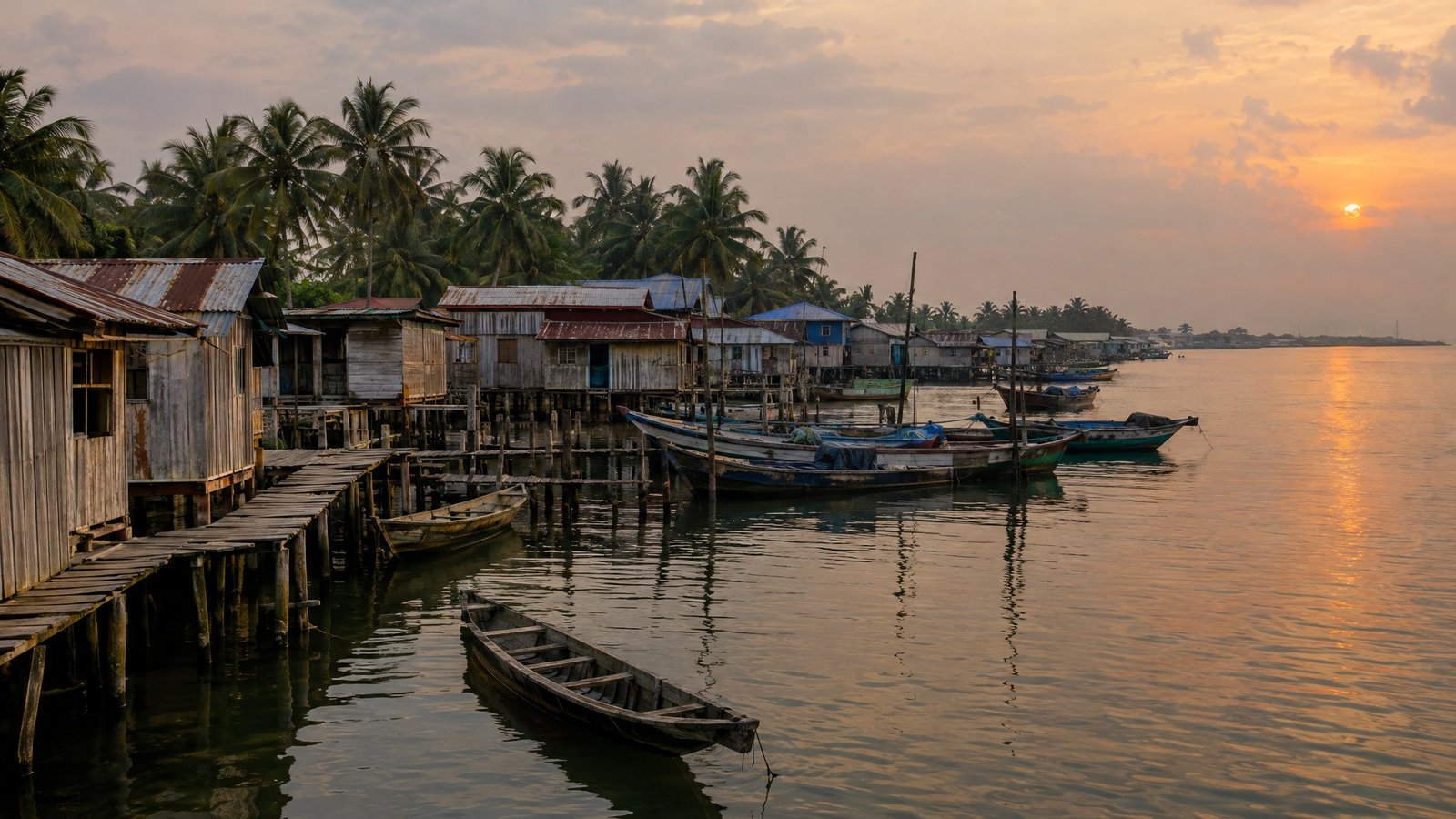
Sogunro and Iwaya sit on the lagoon edge in Lagos, and the geography is not incidental. These are tight, largely informal settlements where families share a narrow strip of land, waterways are the road network, and the boundary between one community and the next is often a matter of custom and memory rather than a surveyed line. Our earlier reporting on the daily pressure on Lagos commuters looked at the transport side of life in the city; the waterfront shows the housing side, where the pressure has nowhere to push out to.
Which is precisely why the coalition’s name matters. A body that pairs demolition and forced eviction with landgrabbing and displacement exists because of a specific and well-documented pattern of waterfront redevelopment in Lagos, where informal settlements are cleared for construction and the people who lived there end up on the edges. When a coalition organised around that pattern also has to call for arrests after five people are killed over a refused party contribution, the arithmetic of the area is doing a lot of work in a very short paragraph.
It is a pattern that has surfaced repeatedly in security reporting from the state. We have covered mass-casualty violence in the country before, and the pattern in police operations against cross-border criminal networks shows what a coordinated response looks like when it happens. The absence of an arrest here is what turns a localised dispute into a grievance with a longer half-life.
Who is affected first
The people who took the first hit are the ones with the least room to absorb it. Fear has forced residents near the boundary between the two communities to abandon their homes. Some of the displaced, the coalition said, took refuge in boats and in the homes of neighbours along the waterfront, avoiding the risk of a further attack.
Living in a boat is not a temporary inconvenience in Lagos. It is exposure to weather, to a police presence that is by definition uneven, to the risk of another raid, and to the simple fact that a house is how a family holds property, documents and a business. People who flee like that rarely come back to the same plot, and when they do not come back, they are still counted in a community that has lost the labour, the customers and the social fabric that made the place a community in the first place.
The eight in hospital carry the other cost. Without knowing the injuries in detail, the reasonable assumption is that some of them are carrying the lifelong consequences that severe violence produces, and that the treatment pathway for trauma patients in the state is the same overstretched system our coverage of the new emergency care rules for hospitals has been following. A violent night in one community becomes a decade of orthopaedic follow-up in a public hospital.
The political economy of a party contribution
What an arrest would actually settle
There is a reason the trigger was so small. A party contribution in a community like this is not a voluntary subscription in the way that word sounds in a middle-class WhatsApp group. It is closer to a local tax, and refusal to pay is legible as a statement of opposition. Where the state has organised itself along party lines and the community has been pulled into that structure, a refusal becomes a flag.
The coalition’s assertion that residents refused to fund the party, and that the response was an armed incursion, is an allegation made by one side. That distinction matters and will not be settled by a press statement. But the sequence it describes — refusal, then a raid with axes and firearms, then looting, then no arrests — is the kind of sequence that Nigerian political entrepreneurs have used before in other parts of the country, where party loyalty is enforced at the level of the compound rather than the polling unit. We have previously looked at warnings about electoral violence ahead of the 2027 cycle, and this incident is exactly the kind of grassroots friction that produces the worst of it.
What would actually settle this is straightforward: arrests, prosecution, and a clear account from the police of whether the attack was criminal or a civil dispute that got out of hand. Until that exists, two neighbouring communities on the same stretch of lagoon are living with the assumption that the next party event will go the same way.
Conclusion
The smaller version of this story
Five dead and eight injured is the headline number, but the more durable story is what happens next. If the police do nothing, the message that goes out is not about law enforcement. It is that a group can cross a boundary, punish a refusal, and return home. That is the lesson people will take from Sogunro, and it is a lesson that does not stay inside one community.
There is a smaller, more hopeful version available. The coalition has named an investigator, asked for arrests and asked for security. Residents have already demonstrated that they will not simply absorb this quietly — they documented the attack, they counted the dead, and they went public within days. What they should not have to do is fill the gap that the police have left, and what the state should not have to do is explain how five people were killed over a party contribution without anyone being charged.