

There is a particular kind of pain that runs through Nigerian family conversations. A man paid for land in 2011. He was told the plot was fully documented. His brother died before the papers were regularised, and today the family is standing on a piece of land with two other families also claiming it.
Land banking — buying land early and letting it appreciate — is genuinely one of the most popular wealth strategies in Nigeria. It is also one of the most dangerous places for an ordinary person’s money to go, because the difference between a good plot and a worthless one is buried in paperwork that most buyers never learn to read.
Here is how to do it properly, from finding the plot to signing the final documents.
Why Nigerians Are Still Buying Land Despite Everything
Land is the one asset that has repeatedly delivered what the naira has not. A plot bought for ₦300,000 in a Lagos outskirts in 2014 can be worth many multiples of that today, and unlike a share or a crypto token, you cannot lose the physical plot to a failed exchange. It is also forced savings — you cannot spend land money on fuel and food, which is precisely why it appeals to people who have watched savings quietly shrink.
There is an inflation argument too. When money loses purchasing power, hard assets tend to hold or gain. Our piece on hedging against inflation and protecting your naira savings covers the wider toolkit, but for many Nigerians, land remains the most trusted instrument in that kit.
Land also behaves differently from other investments. Shares can be sold in minutes. A plot cannot. That illiquidity is a downside for most people, and it is the reason land banking suits a specific kind of buyer: somebody with patient money, a long horizon, and no plan to need cash next month.
The Document Stack: Know Exactly What You Are Buying
Before any discussion of price, you need to know the paperwork. For a residential plot in Nigeria, the core documents are:
- Certificate of Occupancy (C of C) — the strongest title you can hold. It means the government has formally allocated the land to you.
- Governor consent — required to convert a Governor’s consent, the most common residential title, into a C of C.
- Registered survey plan — the document that defines the exact shape, size and location of your plot.
- Deed of assignment — the agreement that transfers the land from the previous owner to you.
- Excision in progress — proof that the land has been carved out of a larger allocation and is being properly surveyed.
- Allocation letter or gazette — evidence the land was genuinely allocated in the first place.
- Receipts for land use charges and development charges — proof the fees were paid.
Two things to note. First, any document that looks photocopied, blurred at the edges, or printed on a different paper from the rest is a reason to walk away. Second, a document you have not personally seen is not a document you own. No exceptions, not even for the pastor who introduced you.
Where to Actually Look for Land
Three routes work in Nigeria, and each carries different risk.
Buying directly from an original allottee
The person named on the original allocation. This is the cheapest route and the safest if the paperwork is clean, because you can trace the chain of ownership all the way back. Ask for the allocation letter, see the original, and confirm the plot physically against a survey plan.
Buying from a reputable developer
Estate companies selling in planned developments with roads, drainage and power. Convenient, and usually more expensive, because you are paying for infrastructure. Check the developer’s track record, visit the site on a weekday, and ask to see completed and occupied units, not just the show unit.
Buying from a native land owner in an area under excision
Cheapest of all, and the most dangerous. Where land has not been excised, ownership is usually a matter of customary recognition rather than documents, and one plot can be sold to five families. If the seller says excision is coming, ask to see the excision in progress and the survey plan for the specific block.
The Verification Steps That Actually Stop Scams
Step one: search the land registry
The state land registry in Lagos, and the equivalent in your state, will show whether a title number is genuine and who is recorded as the holder. Google Maps can confirm whether the same plot has been photographed by sellers on other listings, which is one of the fastest ways to spot a double sale. Our guide to the high-growth industries in Nigeria worth watching in 2026 covers why property keeps ranking so high, but the verification habit matters more than the trend.
Step two: visit the plot with the right people
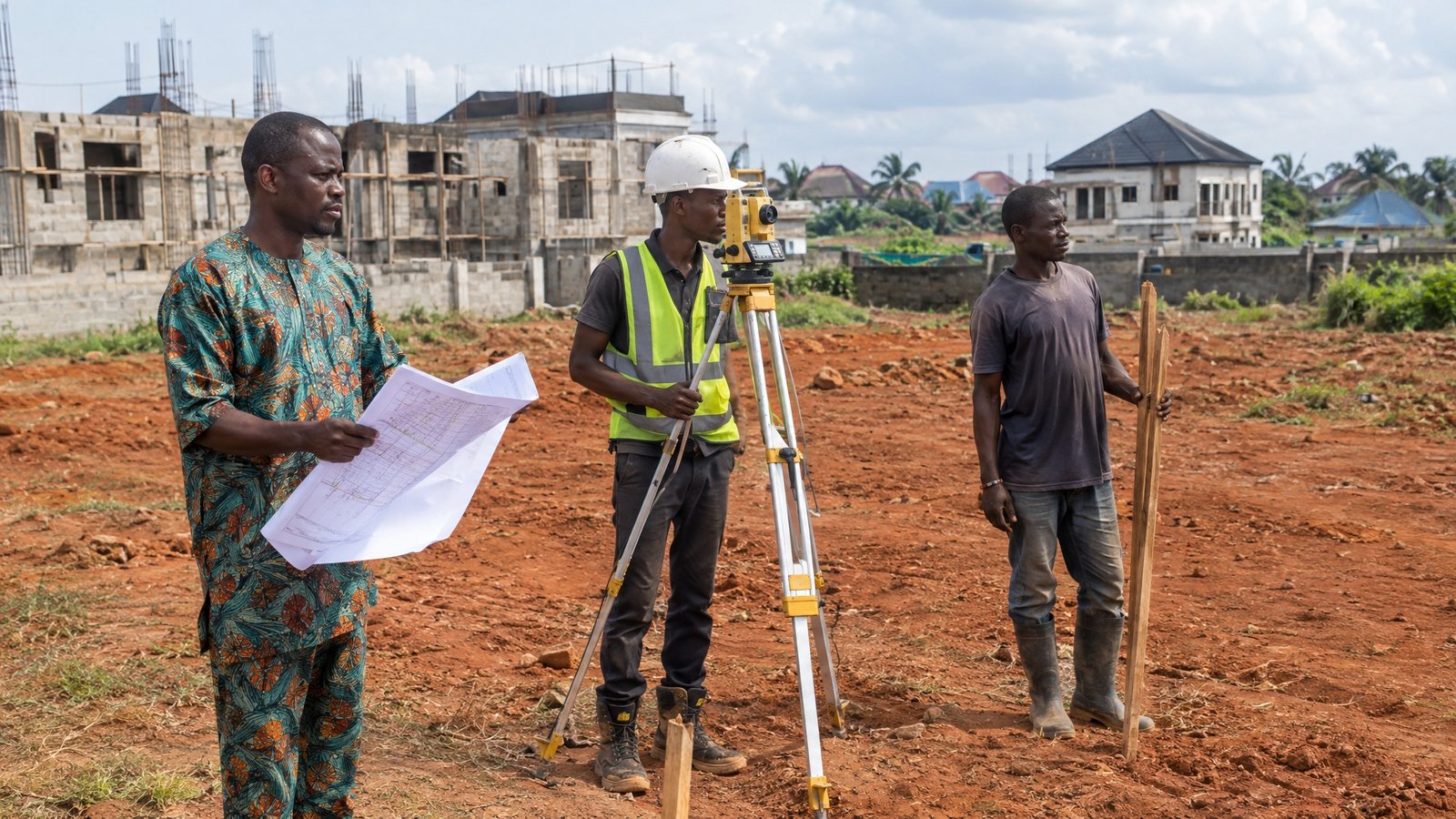
Go to the site with the surveyor and the seller together. If the seller resists, that is your answer. Confirm the plot physically, check that the boundaries match the survey plan, note the surrounding plots, and take photographs with the date on them.
Step three: check the beacons
Beacons are the concrete pillars marking a survey. Make sure they exist and that they are in the right place. A plot with no beacons, or with beacons that do not match the plan, is not properly surveyed.
Step four: verify the chain of ownership
Ask who bought it from, and ask to see that previous sale. A chain you cannot follow to the original allottee is a chain with a gap in it, and the gap is where the dispute will come from.
Step five: never pay the full price to a middleman alone
Pay directly to the seller, or at least pay the bulk of the money only after the deed of assignment is drafted in your favour and the seller’s own title has been verified by your lawyer. A small fee to a solicitor for an hour of work has saved Nigerian families far more than that.
Realistic Expectations on Returns — and Realistic Risks
Nobody can tell you exactly what a plot will be worth in five years, and anybody who does is selling something. Land returns are lumpy. A plot that sat for six years then sold for three times what you paid is the honest Nigerian experience, not a smooth monthly climb. Treat it accordingly: money you will not need for the next decade, in a location with actual demand.
Three risks deserve plain language. Government land use charges and development charges can fall on you years after purchase, so budget a reserve. Titling and Governor consent take time, sometimes years, so keep every receipt and letter in a secure place rather than in a plastic folder in your car. And speculative buying of plots in areas with no roads, no power and no buyers is how people end up owning land they cannot sell or even reach.
If you are still building your financial base, it is worth reading our guide to smart money moves and personal finance in Nigeria before committing a large share of your savings, and our breakdown of the cost of living in Nigeria in 2026 to understand what your money buys today.
Where Land and Business Fit Together
There is a version of land banking that is really business development. Buy a plot in a growing area, build or develop it, and let the income from the property fund your business rather than the other way round. The people who do well with land treat it as an operating asset, not a lottery ticket they hope to resell.
That approach needs a working capital engine. Plenty of Nigerians start with a small trading operation to fund the build-out, and our guide to starting a small business in Nigeria with low capital covers how to get that first engine running without borrowing.
Conclusion
Land banking can make a family in Nigeria, and it has ruined families who bought in a hurry. The difference is almost never the location. It is the paperwork, the verification and the patience.
If you take three things from this guide, take these. See every original document yourself, twice. Pay only after the deed of assignment names you. And buy only what you can afford to hold for years without selling, because the only land that makes anybody money is land that was never in a hurry.
Do your research, take a solicitor with you on the first visit, and if the seller will not allow any of that, walk away. There is always another plot.