

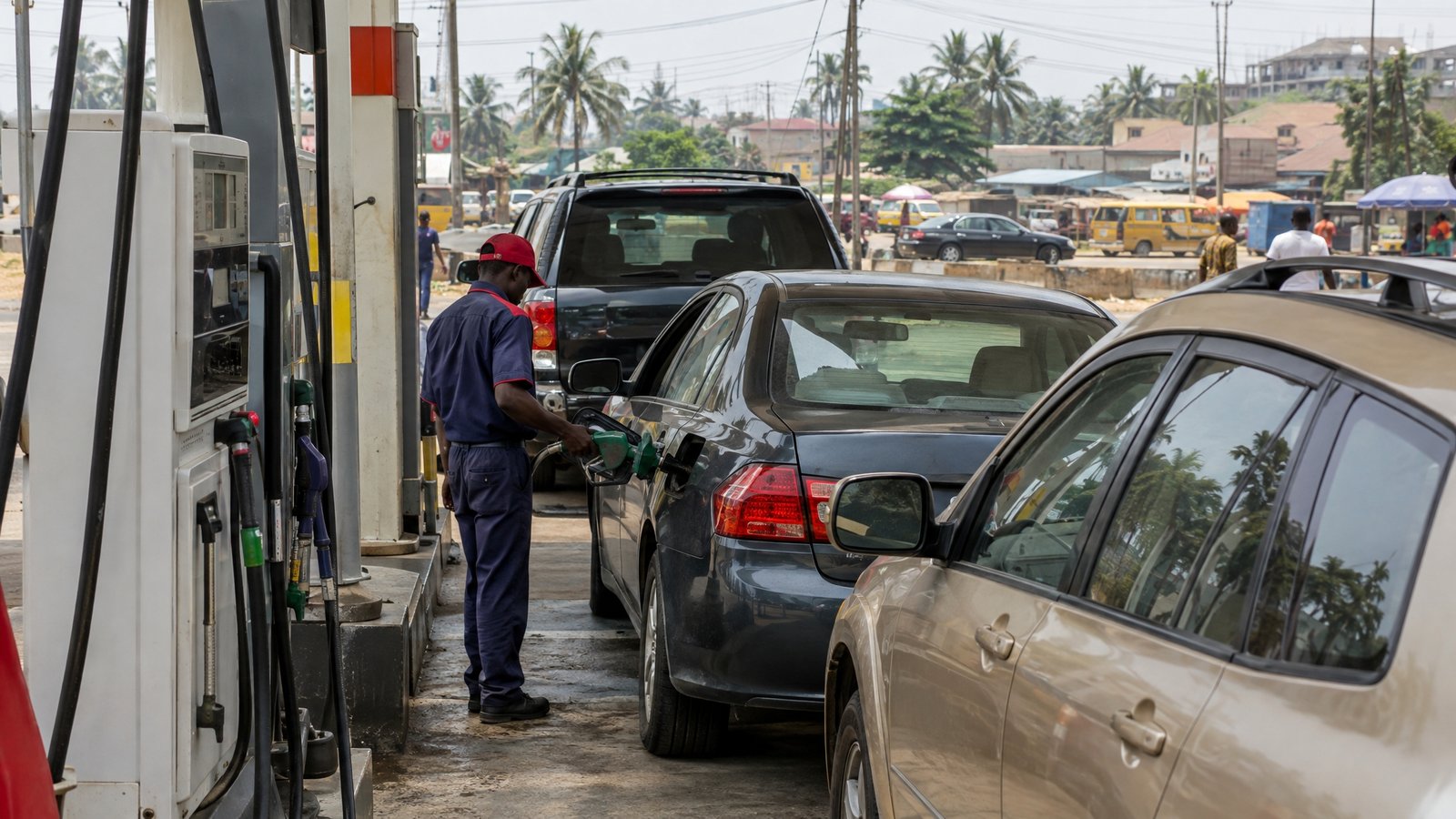
₦1,370 a litre. That is the figure Lagos motorists met at the pumps this week. Stations belonging to the major brands were not charging it — they sat a little lower — but independent marketers were, and the spread between the cheapest and the dearest pump in town is now wide enough that arguing about “the price of petrol” has become pointless.
Here is the picture as it stood after Tuesday’s checks: MRS and NNPC filling stations sold at ₦1,360 a litre, Mobil at ₦1,349, and independent marketers anywhere between ₦1,365 and ₦1,370 depending on where you stood. In other words, a driver filling a 50-litre tank could pay ₦67,450 at one station and ₦68,500 at another on the same street.
Where the money actually changed: the depot table
Pump prices move because depot prices move, and this round of increases started upstream. In Lagos, A.A. Rano raised its premium motor spirit price by ₦75 to ₦1,295 a litre, the sharpest single move on the sheet. Aiteo and Integrated took theirs to about ₦1,300. NIPCO added ₦55 to reach ₦1,305, while Dangote crept up by ₦3 to ₦1,303. MRS held at ₦1,310.
The rest of the country followed the same pattern with slightly smaller steps. In Port Harcourt, Matrix added ₦15 to ₦1,300, with Bulk Strategic, Masters and TSL sitting at the same level. Warri recorded ₦17 increases at A.Y.M. Shafa and Matrix, and a ₦15 rise at Parker, all landing on ₦1,300. Calabar came out a little higher, with Fynefield and Northwest both at ₦1,360.
None of these are small numbers, and none of them arrive in isolation. We have been here before: filling stations dropping pump prices to ₦1,295, Dangote trimming the gantry price as crude slid, and a longer arc of petrol prices after the removal of the fuel subsidy that has swung both ways. What is different today is the gap between depot and pump, which is where the disagreement between drivers and dealers usually starts.
The twist: diesel is moving the other way
Here is the part that rarely makes it into the headline, and it is arguably the more useful number in the whole exercise. Automotive gas oil — diesel — did not follow petrol up. In Lagos, WOSBAB cut its diesel price by ₦21 to ₦1,809 a litre and Bulk Strategic trimmed ₦15 to ₦1,835, while Rain Oil sat at ₦1,850 and Dangote at ₦1,823. In Warri, Matrix and Rain Oil each shaved ₦5 to ₦1,835, and Edo Refinery, NIPCO and Prudent held at ₦1,840.
Petrol and diesel are separate products with separate pricing logic, and they serve different customers. Almost every private car on the road burns petrol; almost every bus, truck and generator runs on diesel. So the same week that shaves a few naira off the diesel bill of a transport operator adds to what a family pays to fill up.
What it does to a household budget
Do the arithmetic honestly and the number is manageable but no longer trivial. A 50-litre fill at ₦1,370 costs ₦68,500. The same fill at the ₦1,295 price from earlier in the year cost ₦64,750. That is a difference of ₦3,750 for one tank. For a household filling twice a month, it is about ₦7,500 a month, or roughly ₦90,000 across a year, before any other transport cost is counted. A driver covering 400 kilometres a week in a car that does 10 kilometres to the litre burns about 40 litres a week — roughly ₦55,000 every week, and more than ₦235,000 in a month.
Nobody needs to be an economist to see what that does to fares, food prices and the little that is left over. We have already watched fuel and cooking gas costs squeeze the same households from two directions — the pot and the car — so this is not a single-line problem for a family budget.
What usually happens in the days after a depot move
Depot prices filter into retail outlets rather slowly and unevenly, which is why two stations on the same road can disagree by more than ₦100. Retailers usually adjust within days, sometimes within hours for stations that turn over stock quickly, and the pattern is not always the same everywhere — a depot with a longer haul to a far-flung market often moves later than one selling next to a terminal.
Two practical habits help. The first is to know the price at the three stations closest to your route rather than the price shouted at the one you happen to pass. The second is that when depot prices are visibly moving upward, filling earlier rather than later is a decision many regular motorists make. Neither habit changes the trend, but both stop a bad week from becoming a bad month.
Conclusion
Petrol at ₦1,370 in Lagos is a return to the painful end of a range Nigerians have been living with since the subsidy went, and it is happening while diesel quietly retreats. That split matters more than the headline: it means the cost of moving goods and people by bus and truck is not rising in step with the cost of driving a private car.
It also keeps the currency story uncomfortable. The naira has been recording consecutive days of appreciation against the dollar, yet what lands at the pump is still moving upwards, because the fuel market does not run on the spot rate alone. Depot prices, forex availability and the cost of moving product from the terminals to the stations all sit behind that number.
Watch the depot sheet, not the pump board. The pump board is a photograph of what happened; the depot sheet is where next month is being decided.