

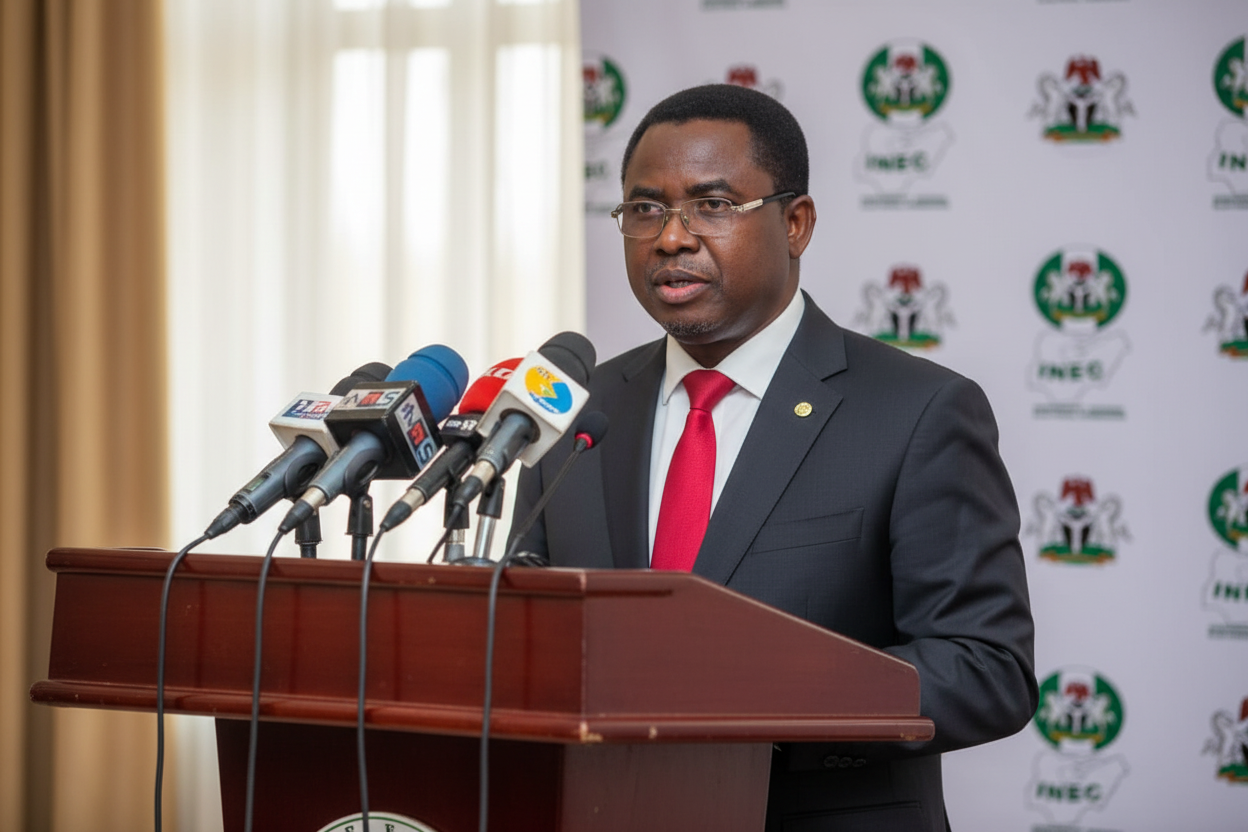
Wahala for who no sabi court order! The Independent National Electoral Commission (INEC) has come out strong, telling the African Democratic Congress (ADC) to cool down on their demands for Professor Joash Amupitan, the INEC Chairman, to resign. This whole drama started because INEC removed some ADC leaders’ names from its portal, a move the ADC sees as partisan bias.
INEC’s Stance: Constitution Over Party Demands
During a recent press conference in Abuja, the ADC, led by its National Chairman, David Mark, loudly called for Prof. Amupitan’s head. They accused him of playing partisan politics, especially after INEC’s decision to delist some of their party leaders. But INEC isn’t having it. They’ve made it clear that while they respect everyone’s right to air their views, they are a creation of the Nigerian Constitution, and their actions are guided by it.
Adedayo Oketola, the Chief Press Secretary to the INEC Chairman, explained that how the Chairman and National Commissioners are appointed, how long they serve, and how they can be removed are all clearly spelt out in Section 157 of the 1999 Constitution. In simple terms, the INEC Chairman doesn’t serve at the pleasure of any political party. So, any call for his removal outside what the Constitution says is just a distraction and a direct attack on INEC’s independence.
Why INEC Delisted ADC Leaders: Obeying Court Orders
INEC went further to explain that their decision to remove the ADC leaders’ names was purely to obey a recent Court of Appeal judgment. They didn’t want to repeat the issues seen in Zamfara and Plateau States, where elected officials were sacked because court judgments were ignored. Also, they had a ‘preservative order’ from the court, telling them not to do anything that would make ongoing court processes useless.
Monitoring congresses and conventions for the David Mark-led ADC, according to INEC, would have been a direct disobedience of that court order. They also pointed out that they only recognised David Mark’s Exco on September 9, 2025, which was seven days after the matter was already in the Federal High Court. The law says ‘status quo ante bellum,’ which means maintaining the situation as it was before the conflict started. INEC emphasized that Section 287(2) of the Constitution mandates everyone to obey and enforce Court of Appeal judgments.
INEC’s Commitment to Fair Play and Voter Revalidation
INEC vehemently denied undermining the multi-party system. In fact, under Prof. Joash Amupitan, they’ve expanded the democratic space by registering new parties like the Democratic Leadership Alliance (DLA), the Nigeria Democratic Congress (NDC), and the National Democratic Party (NDP), bringing the total to 22 active political parties. This, they say, proves they are a neutral regulator, not a political participant. Their updates to party leadership records are always based on court orders and the Electoral Act 2026.
The Commission also addressed concerns about the planned nationwide Voter Revalidation exercise, which some are trying to politicise. INEC clarified that this exercise was planned long before Prof. Amupitan’s appointment. It’s a professional necessity to ensure the integrity of the National Register of Voters, which currently holds data from 2011 to 2024. This isn’t a fresh registration but an administrative audit to confirm voter status, address transfers, multiple registrations, and deceased persons, making the voter data more reliable. It’s not targeted at any region, party, or group; it’s a uniform, transparent process for all.
For now, INEC is laser-focused on the upcoming Ekiti (June 2026) and Osun (August 2026) off-cycle elections. They are not interested in distractions or baseless accusations of bias. Their loyalty is to the Constitution and the Nigerian people. While some decisions might not sit well with individual parties, INEC is committed to creating an electoral environment where transparency and fairness are paramount. Their decisions are based on thorough evaluations and legal frameworks to ensure free, fair, and credible elections for everyone, not just specific political groups.
For more insights into Nigerian politics and how various government policies impact citizens, read our other articles: N1bn MSME Grants, How AI Can Scale Your Business, The Rise of Nigerian Tourism, How to Make Money Online in Nigeria, Archbishop Hezekiah on New Tax Policy.
For more insights, read our other articles: N1bn, How, The, How, Hezekiah.