
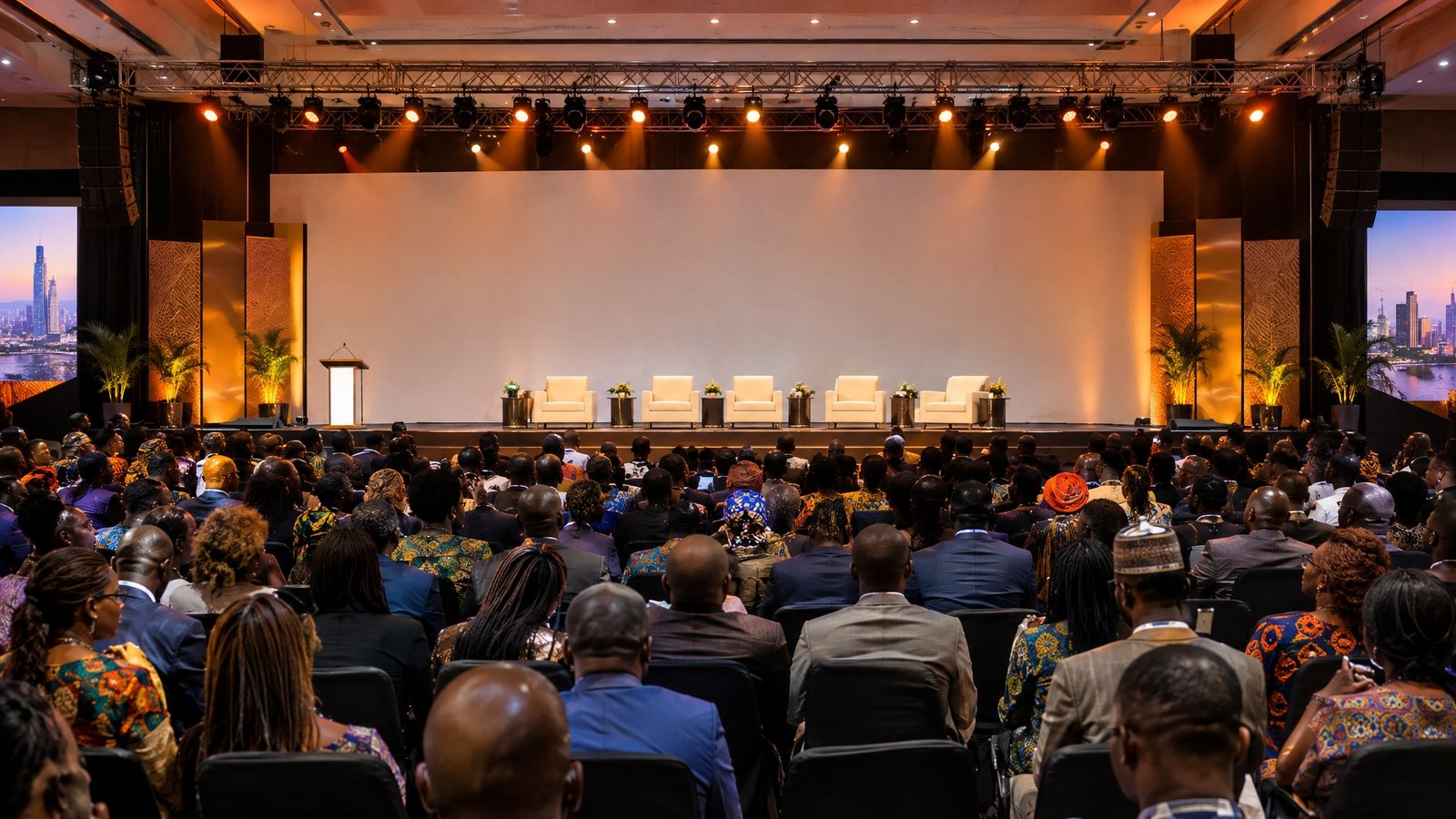
Somewhere between 17,000 registered participants and a stage full of people who spend their lives arguing about royalties, something unusual happened in Lagos this week. The Creative Africa Nexus Weekend 2026 opened on Thursday at the city’s waterfront, and the message from every podium was the same: the money in African creativity is real, it is measurable, and until now African creators have been handing most of it to somebody else.
The four-day gathering, running to 8 November under the theme “One People, United in Culture, Creating for the World”, is hosted by the Federal Government and organised by Afreximbank. For Nigerian creators, investors and small business owners, it is worth more than a conference photograph, because the useful part is happening in the deal rooms.
The number that opened the summit
Afreximbank President and Chairman Dr George Elombi told the opening ceremony that the bank is targeting creative industry deals worth more than $540m at this year’s edition, and then did something unusual with the figure. “Lagos has to be several multiples of 540. So let Lagos set the mark, and I’m sure that mark will be hard to catch up elsewhere,” he said.
It is a competitive framing, and it tells you how seriously this bank now treats the creative economy. The institution has moved its creative industry financing commitment from $500m to $1bn and then to $2bn in 2024. It runs a Pan-African Film Fund, has put money into recording studios, fashion manufacturing and entertainment venues, and through CANEX Creations Inc. has bought into African intellectual property itself – film projects and music catalogues, the assets that used to be invisible on every balance sheet.
The problem everybody is trying to fix
The framing figures are stark. Estimates attributed to the United Nations Economic Commission for Africa put Africa’s creative economy at roughly $60bn, which is about two per cent of the global creative industry. In other words, the content is winning and the money is not.
Elombi put it bluntly: “So too often, the African creators make the hits, and someone else makes the money.” His diagnosis was that foreign control of distribution networks, branding, marketing platforms, intellectual property rights and content catalogues is the reason creators retain so little of what they produce. He added a warning that is genuinely new: digital algorithms increasingly decide which African songs and films reach international audiences, and artificial intelligence is now reproducing creators’ work without permission.
“Our talent is global, but our share of the value is not,” he said. His conclusion was that financing production alone will not fix it. Unless African businesses also own distribution, marketing and the other profitable parts of the chain, the money will keep leaving.
What Nigeria brought to the table
Vice President Kashim Shettima opened the summit with an appeal aimed straight at the money men in the room: “The next great global creative companies will come from Africa. Back them early, and back them here.” He told delegates not to leave with photographs only – “Do not leave Lagos with memories alone; leave with a signed term sheet, a distribution deal, a buyer’s handshake. The world is ready to pay for what you make.”
He also announced that creativity is now being treated as a trade sector rather than a cultural luxury, pointing to Federal Government work on intellectual property protection, cross-border payment barriers and the African Continental Free Trade Area.
Minister of Industry, Trade and Investment Dr Jumoke Oduwole gave the numbers on the Nigerian side: over $600m in financing being unlocked for digital and creative enterprises through the Investment in Digital and Creative Enterprises programme, a national intellectual property policy and strategy approved in November 2025, and a creative sector investment playbook unveiled at the World Economic Forum in January 2026. She also confirmed that registration for CANEX 2026 was stopped at 17,000 participants, against 6,000 at the previous edition.
Lagos State Governor Babajide Sanwo-Olu told the creators to stop treating their work as a hobby. “Your talent is not just a hobby any longer. It is indeed an export,” he said, noting Lagos investments in theatres, cultural facilities, fashion events and artistic programmes, and pointing to the city hosting the Intra-African Trade Fair in 2027.
The practical guide: what a Nigerian creator should actually do this weekend
- Get into the Deal Room and the pitch sessions. These are where entrepreneurs are put in front of financiers and investors looking for opportunities across film, television, music, fashion, sport, publishing, gastronomy and visual arts. Bring a one-page pitch, a revenue model and your IP status.
- Register your intellectual property before you leave. Elombi’s line was the most practical of the summit: “The right that is not on record cannot be financed. And the royalty no one can audit cannot be priced.” Unregistered work cannot be used as collateral. Nigeria’s Secured Transactions in Movable Assets Act of 2017 is the legal hook lenders are being asked to use.
- Enter the CreaThon. The creative hackathon is being run with Gebeya, with a $50,000 prize pool. Sessions on intellectual property investment, artificial intelligence and digital tools also run through the programme.
- Sit in on the Creative Economy Finance Summit with the Creative Economy Practice at Co-Creation Hub, where the discussion is about structuring, financing and de-risking creative deals rather than simply producing content.
- Keep the paper trail. If you want lenders to lend against royalties, you need registered rights and reliable earnings records. That is unglamorous, and it is the single thing that most separates creators who get financed from creators who get a cheque for one film.
How to judge what the summit actually produced
The marketing will be enormous, so judge it by paperwork. Elombi said the bank will assess the contracts signed, the studios established, the intellectual property acquired and the livelihoods created once the gathering closes. That is the correct test, and it is the same test that should be applied to every creative finance summit: what did you leave with that you could not have got from a PDF?
It is worth remembering what else is moving in the same direction. The FinTribe Finance Fair put African women investors and founders in one room, and the 99th pharmacy conference in Awka showed the same appetite for professionalising a sector. Meanwhile Nigerian public markets are moving too – the Dangote refinery IPO is testing whether ordinary Nigerians will back big domestic assets – and the report on Nigerian tech startups keeping US ties is a reminder that global capital and local ambition are not the same thing.
Conclusion: the real deadline is Monday
CANEX 2026 is a four-day event with a much longer tail. The summit ends on 8 November; the useful work starts afterwards, when a creator has to turn a conversation into a signed term sheet, a registered right and a bankable royalty record. If you are in Lagos for the weekend, go to the deal rooms rather than the stage. And if you are not in Lagos, do the part that costs nothing: register your work, organise your earnings records and start treating your catalogue as an asset rather than a memory.