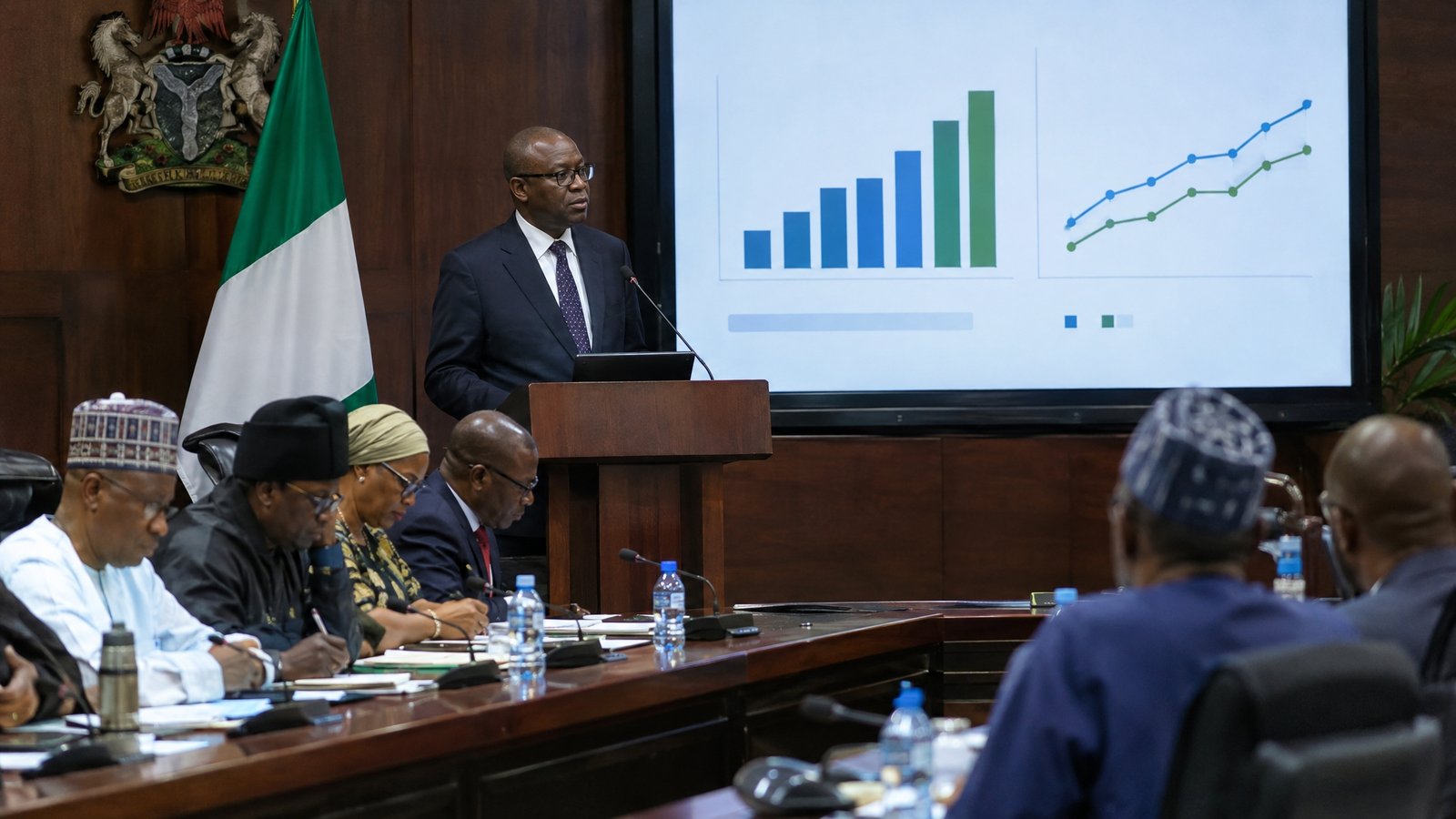
Budget news in Nigeria has a habit of arriving with a number that looks impressive and a second number that does not. The first quarter 2026 figures just published by the Budget Office of the Federation are a clean example. The headline deficit came in at N4.69 trillion, which is N3.18 trillion below the prorated target of N7.86 trillion. On paper, that is good news. Then you read the revenue line, and it stops looking like good news.
The federal government collected N5.08 trillion in revenue against a quarterly target of N9.22 trillion. That is a shortfall of N4.14 trillion, meaning only about 55 per cent of expected money came in. Spending came in at N9.76 trillion against a N17.08 trillion plan, about 57.2 per cent of target.
How the Money Was Meant to Be Raised, and What Actually Happened
The financing plan behind the budget was specific, and the report tracks each line against it.
- Domestic borrowing: N3.9 trillion raised against a prorated target of N4.61 trillion — a shortfall of N704.03 billion.
- Foreign borrowing: N2.70 trillion was projected for the quarter. Actual inflow: nothing at all.
- Project-tied loans from multilateral and bilateral lenders: N287.44 billion realised against a N512.23 billion target.
- Privatisation proceeds: N3.32 billion against a projected N47.29 billion.
Read that last line again. The plan counted on N47.29 billion from privatisation in three months and got N3.32 billion. That is not a rounding error in the plan. That is a specific revenue stream that did not materialise on anything close to the expected scale.
So Why Is the Deficit Below Target?
Because the government spent less than it planned, not because it took in more than it planned. Expenditure came in N7.32 trillion under the quarterly target. The deficit looks comfortable largely because implementation is running slow on both sides of the ledger. A smaller deficit created by under-spending is not the same achievement as a smaller deficit created by stronger revenue.
This is the distinction that matters for anyone watching the 2026 budget, and it is the one most headline treatments of the figure will skip.
The Economy Grew, and That Is Not Nothing
Alongside the fiscal numbers, the report put out growth data that complicates the story in the other direction. Nigeria’s economy expanded by 3.89 per cent in real terms during the quarter. The oil sector grew 2.57 per cent year-on-year, an improvement of 0.70 percentage points on the 1.87 per cent recorded in the same period of 2025. The non-oil sector grew faster still, at 3.94 per cent, and accounted for the larger share of overall growth.
The Budget Office described the quarter as a period of macroeconomic stabilisation accompanied by moderate real-sector expansion, and identified weak but improving revenue performance as the main constraint on budget execution. The important word there is improving. The direction is right. The level is not.
The Government’s Own List of Fixes
The report did not stop at the diagnosis. The strategies named for strengthening the economy were specific: oil production recovery, tax-base expansion, improved tax compliance, increased domestic production, agricultural productivity, infrastructure development, private-sector credit and export diversification.
Two lines from the report deserve repeating. The first is that improving revenue collections in the remaining quarters is critical to the successful execution of the 2026 budget. The second is that the central policy challenge for the remainder of the year is not simply to preserve stability, but to convert stability into higher productive capacity and stronger domestic revenue mobilisation.
There is also an admission in there about the spending side: controlling recurrent expenditure, particularly personnel costs, and addressing security challenges remain important for improving fiscal performance. Staff costs are the line that is politically hardest to touch and easiest to grow.
The Part on Private-Sector Credit
The report argued that consolidating gains in inflation management, exchange-rate stability and the external sector would require creating sufficient room for productive private-sector credit, investment and employment generation. That is the sentence to hold on to. If the government wants credit to flow to businesses, it has to borrow less domestically or raise more revenue, because every naira that goes to debt service is a naira not available for lending.
Our coverage of the National Assembly’s consideration of the new foreign loan request sits directly alongside this report, and the sequence matters: the borrowing decision was being taken while the receipts were coming in at 55 per cent of plan.
What This Means For the Rest of 2026
Three practical consequences.
The revenue target will need to move, or the spending target will. With a N4.14 trillion quarterly shortfall and four quarters still to run, the gap between what was planned and what is coming in has to be closed somehow. Historically that means either the budget is revised mid-year or the deficit simply grows against the original target.
Foreign borrowing has to actually land. The zero inflow on a N2.70 trillion plan is the single most fixable-looking item and the one most exposed to external conditions. When it is all still unused, the arithmetic is manageable. When it is not, the domestic market absorbs more of the funding, and that is where borrowing costs show up for ordinary Nigerians. We have tracked how quickly the naira moved against the dollar in a single week for a sense of how fast that sentiment turns.
Projects will feel the squeeze first. Capital budget execution is the first thing to slow when recurrent spending is protected. We have looked at how a previous national power addition, the commissioning of six substations adding 640MW to the grid, translates into something people can feel — and at how much longer the distance is between a commissioning and a result.
Why This Report Matters Beyond Budget Geeks
Budget performance reports are usually filed as paperwork. This one lands at a moment when the cost-of-living debate is the loudest it has been, and when the government is simultaneously running a major cash transfer programme. Money that does not come in as revenue has to be borrowed, and money that is borrowed costs interest that the budget eventually has to service.
There is also a governance point the report makes deliberately. The Budget Office reaffirmed its commitment to transparency and accountability, promising firm adherence to budget implementation guidelines and the governance framework on monitoring capital budget implementation, with efforts focused on improving execution efficiency and ensuring effective project management in the remaining quarters of 2026.
That commitment will be judged on whether the revenue actually rises. We will be watching the second and third quarter reports for exactly that, alongside the running story on the state police bill now sitting with the President for assent, another item with real budgetary weight attached to it.
Conclusion
N4.69 trillion is a better deficit number than the plan required, and that is genuinely worth saying. But it was achieved by spending three-quarters of what was scheduled, not by collecting three-quarters more money, and the second quarter is where the difference becomes visible.
Watch three things: whether quarterly revenue climbs towards N9 trillion, whether the foreign borrowing line finally records inflow, and whether capital projects resume at pace. The Budget Office has committed to better execution in the remaining quarters. The next report will say whether that commitment held.